
A Must-Have Skill for Today’s Permanent Makeup Artist
Permanent makeup has evolved tremendously over the past several years. Today’s clients are increasingly looking for brows that are polished, soft, natural-looking, and customized to their facial features—not eyebrows that look heavily outlined or overly saturated.
One technique has become especially important for the modern PMU artist: Ombré Brows, also commonly called Powder Brows or Ombré Powder Brows.
At Arizona Permanent Makeup Academy (AZ PMU Academy), we believe learning proper machine shading is an essential part of becoming a versatile permanent makeup artist. Unlike microblading, which creates individual hair-like strokes, ombré brows use a PMU machine to gradually build pixels of pigment within the brow.
The result can range from extremely soft and natural to a more defined makeup effect, depending on the client’s preferences, skin type, existing brow hair, and overall facial structure.
Why Are Ombré Brows So Popular?
One of the biggest advantages of the ombré technique is its versatility.
Rather than creating the same brow on every client, an experienced artist can control the density and placement of pigment to create a customized result.
A classic ombré brow generally features:
● Soft, diffused fronts
● Gradually increasing color through the body of the brow
● Greater definition toward the arch and tail
● Smooth transitions without obvious blocks of color
● A polished powder-makeup appearance
The goal is not simply to “fill in” an eyebrow. The artist is creating a controlled gradient that complements the client’s natural brow growth and facial structure.
1. Great Ombré Brows Begin With Great Brow Mapping
Before the machine is ever turned on, the artist must understand brow design and facial balance.
There is no single eyebrow shape that works for everyone.
Whenever possible, the client’s natural brow should serve as the foundation for the design. Existing hair growth, facial proportions, bone structure, muscle movement, and the client’s desired result should all be considered.
Artists should evaluate:
Brow fronts: Where should the brows begin?
Arch placement: Where is the most flattering high point based on the client’s anatomy?
Tail placement: Does the tail complement the eye and facial structure without visually pulling the face downward?
Thickness: Does the proposed shape work naturally with the client’s existing brow hair?
Symmetry: Are the brows visually balanced while respecting the fact that human faces are naturally asymmetrical?
Mapping tools such as measuring string, calipers, rulers, and mapping pencils can help establish proportions. However, tools should support—not replace—an artist’s understanding of facial anatomy and visual balance.
Work With the Client’s Natural Brows
One of the most common beginner mistakes is trying to create an entirely new eyebrow instead of improving the eyebrow that is already there.
A well-designed permanent brow should generally enhance the client’s natural features.
For clients with sparse areas, the artist may create the appearance of additional fullness. For clients with downward-growing or missing tails, careful design may help create a more lifted visual appearance.
The objective is enhancement rather than transformation for transformation’s sake.
2. Soft Borders Are Essential
A beautiful ombré brow should not look as though it was outlined with a marker.
Visible, harsh borders can make permanent makeup appear artificial, particularly once the pigment has healed.
An outline used during the procedure is primarily a working guide. It should help the artist maintain the intended shape without becoming a permanently visible frame around the brow.
Special attention should be given to the front of the brow.
A classic ombré effect normally begins very softly and gradually becomes more saturated toward the body and tail. A heavily defined square at the front can eliminate the softness that makes this technique so attractive.
Think:
Soft front → gradual transition → increased definition → refined tail
The transition should appear seamless.
3. Less Can Be More in Permanent Makeup
Permanent makeup should be approached differently from conventional makeup.
A client can easily add additional pencil or powder for an evening or special occasion. Removing excessive permanent pigment is much more complicated.
For that reason, beginner artists should resist the temptation to chase extremely bold social-media brow trends.
Overworking the skin or repeatedly depositing pigment in pursuit of an immediately dark result can contribute to unnecessary skin trauma and undesirable healed results.
A more controlled approach allows the artist to gradually build density while continuously evaluating the skin and pigment deposit.
Remember:
You can build more color. You cannot simply erase excessive saturation.
This principle becomes particularly important when working with permanent makeup that may be refreshed multiple times throughout a client’s life.
4. Creating the Ombré Gradient
The defining feature of an ombré brow is the transition in density.
Rather than placing the same amount of pigment throughout the entire eyebrow, the artist strategically changes the concentration of pixels.
The front should generally contain fewer visible pixels and greater skin visibility. Density can then gradually increase through the body, arch, and tail.
Think of the eyebrow as a gradient rather than a solid block.
A successful gradient requires control of several variables, including:
● Hand speed
● Machine speed
● Needle choice
● Stretch
● Pressure
● Movement pattern
● Number of passes
● Pigment selection
● Skin response
This is why ombré brows may appear simple when watching an experienced artist but require substantial practice to perform consistently.
5. Understanding Needle Configurations
A professional PMU artist should understand that different needle configurations can produce different effects.
There isn’t one universal needle that must be used for every ombré brow.
Depending on the technique, machine, skin characteristics, and desired effect, artists may work with configurations such as:
1RL – Round Liner
Useful for controlled, detailed pixel work and gradually building saturation.
3RL – Round Liner
Offers slightly broader coverage while maintaining control.
Round Shaders
Can be useful for creating broader areas of soft shading.
Magnum Configurations
May provide wider coverage for certain shading applications when used by an artist trained in the configuration.
As the grouping becomes larger, the artist can generally cover a broader area with each movement. Smaller configurations allow more detailed placement.
But needle selection alone does not create beautiful brows.
The artist must understand how the chosen needle interacts with the machine, pigment, skin, hand movement, and technique.
6. Skin Type Matters
One reason machine-shaded brows are such an important skill is that not every client is an ideal candidate for hairstroke techniques.
Skin characteristics can influence technique selection and healed results.
An artist should evaluate factors such as:
● Oiliness
● Pore size
● Skin thickness
● Sensitivity
● Previous permanent makeup
● Existing brow hair
● Scar tissue
● Sun exposure
● Client lifestyle
● Medical history and contraindications
Rather than automatically performing the technique a client requests, a trained artist should assess the individual and discuss realistic options and expectations.
This consultation process is an important part of professional PMU practice.
7. Understanding Pigment Selection
Color theory is just as important as technique.
Choosing a pigment simply because it looks attractive in the bottle is not enough.
Artists should consider the client’s natural brow hair, skin characteristics, undertones, desired intensity, previous pigment, and how the selected pigment system is designed to heal and age.
Pigments can also behave differently depending on their formulation.
Professional PMU education should therefore include not only color selection but also an understanding of pigment composition, color theory, implantation, healing, fading, and long-term maintenance.
8. Fresh Brows Are Not Healed Brows
One of the most important lessons for new PMU artists is understanding the difference between an immediate result and a healed result.
Immediately after an ombré procedure, brows may appear darker, warmer, sharper, or more intense than they will after healing.
The true measure of an artist’s technique is not simply how impressive the brows look immediately after the appointment.
Artists should evaluate their work after healing.
Ask:
Did the gradient remain soft?
Was pigment retention even?
Did the shape heal as intended?
Are the borders still subtle?
Were there areas of excessive or insufficient saturation?
How did the selected pigment heal in this client’s skin?
Studying healed work is one of the most valuable ways for a permanent makeup artist to improve.
9. Avoid Overworking the Skin
PMU artists are working on living tissue—not paper or a synthetic practice pad.
The objective is controlled pigment implantation while minimizing unnecessary trauma.
Excessive pressure, repeated passes, inappropriate technique, or repeatedly working over irritated tissue can increase the risk of complications and negatively affect healing.
Professional training should teach students to observe the skin continuously and understand when enough work has been performed.
Knowing when to stop is a skill.
10. Practice Before Speed
New artists often focus on how quickly experienced professionals complete procedures.
Speed should not be the first goal.
Control comes first.
Students should develop consistent hand movements and machine control on practice materials before progressing under supervision to live models.
Work on:
● Consistent pixel placement
● Smooth pendulum and shading movements
● Hand speed
● Machine control
● Stretch
● Gradient development
● Clean transitions
● Needle awareness
Speed develops naturally as technique becomes more consistent.
Ombré Brows vs. Microblading: Why Artists Should Learn Both
Microblading and ombré brows create very different effects.
Microblading is primarily designed to simulate individual hairstrokes, while ombré brows create a soft, powdered appearance through machine shading.
Some clients may prefer hairstrokes. Others may be better suited to machine shading. Some may benefit from a combination approach.
This is exactly why today’s PMU artist benefits from learning multiple techniques rather than relying on one method for every client.
The more techniques an artist understands, the better equipped they are to customize services based on the individual sitting in front of them.
Learn Ombré & Powder Brows at Arizona Permanent Makeup Academy
At Arizona Permanent Makeup Academy, our goal is to teach students more than simply how to operate a PMU machine.
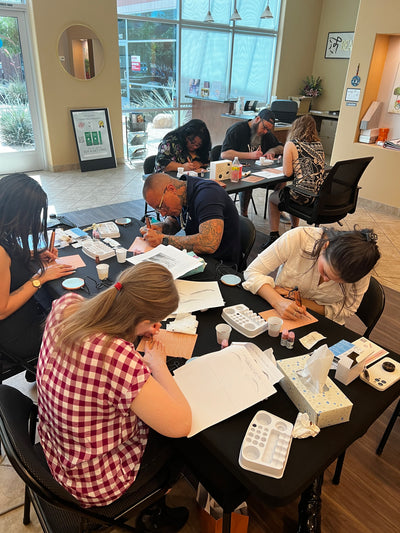
Students learn the fundamentals behind professional permanent makeup, including brow design, color theory, skin knowledge, machine techniques, needle selection, sanitation and bloodborne pathogen safety, client consultation, aftercare, and supervised practical application.
Our beginner permanent makeup programs include modern machine brow techniques such as Ombré Brows and Powder Brows, along with additional permanent makeup techniques designed to help students develop a well-rounded foundation.
Students also receive continued support after completing their training, including opportunities for additional practice and refresher education.
Whether you are completely new to permanent makeup or an existing artist looking to expand your machine skills, mastering ombré brows can become one of the most valuable techniques in your professional toolkit.
Ready to Learn?
Arizona Permanent Makeup Academy
Peoria, Arizona
📞 480-823-6249
🌐 AZPMU.org
Explore our permanent makeup training programs and learn the techniques behind today’s most requested brow styles.

Leave a comment