
Line Work Fundamentals in Tattooing
Line work is the foundation of every successful tattoo. Whether you are creating permanent makeup, paramedical tattoos, or traditional body art, clean, consistent lines begin with proper technique, depth control, and stabilization. At Arizona Permanent Makeup Academy (AZ PMU Academy), we emphasize mastering line work early in your education—immediately after completing hygiene and safety training which is provided free of charge with any training—because precision and sterilization are essential for professional results.
Proper Machine Grip & Control
Correct machine grip plays a critical role in line consistency and depth control.
Standard Line Work Grip Technique:
-
The middle finger is placed directly underneath the cartridge to support and stabilize the needle.
-
The index finger and thumb wrap around the grip to guide the machine.
-
The remaining fingers are tucked in for tighter control and consistent depth.
-
The hand glides smoothly across the skin rather than floating, allowing controlled needle penetration.
This grip allows artists to pull lines smoothly. To push lines, the machine position shifts slightly into the pocket between the thumb and index finger—without changing finger placement—maintaining stability while adjusting direction.
Disposable Grips & Comfort Wrapping
For safety and hygiene:
-
Machines must always be fully bagged during procedures.
-
Disposable grips are required for live models and clients.
For extended sessions, grips may be wrapped with self-adhesive athletic wrap to improve comfort and reduce hand fatigue. However, wrapping alone does not replace proper barrier protection and must never be used without disposable grips and machine bags.
Stabilization: The Three Points of Contact
Professional line work depends on stabilization. At AZ PMU Academy, we teach the three-point contact method:
-
Machine Hand – Proper grip and controlled movement
-
Anchor Point – Resting your hand on the client or table
-
Stretching Hand – Stretching the skin to create a smooth surface
For additional support during early practice, students may temporarily lock the pinky finger of the tattooing hand with the thumb of the stretching hand to increase stability while learning.
Understanding Correct Tattoo Depth
One of the most common beginner challenges is finding the correct depth.
Optimal Tattoo Depth:
-
Approximately 2 mm into the skin
-
This places the pigment into the dermis layer, where ink can properly settle and heal
Depth Indicators:
-
Too shallow: Ink sits in the epidermis and fades during healing
-
Too deep: Ink enters fatty tissue, causing blowouts and blurred lines
-
Correct depth: Smooth, consistent lines without tearing or cutting the skin
Practice Materials & Skin Selection
We strongly recommend practicing on 3 mm thick synthetic skins, as they accurately mimic real skin depth. Thin (1 mm) practice skins do not allow students to properly learn depth control and often lead to incorrect technique.
Proper practice skins allow students to:
-
Visually inspect depth by cutting cross-sections
-
Identify tearing, blowouts, or surface-level lines
-
Build muscle memory safely before live model work
Why Line Work Mastery Matters
Clean line work:
-
Creates strong tattoo structure
-
Prevents premature fading
-
Reduces trauma to the skin
-
Ensures long-term healed results
-
Protects client safety and comfort
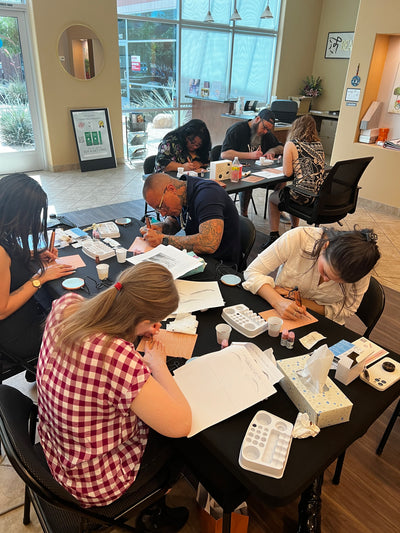
At Arizona Permanent Makeup Academy, line work training is progressive. Students build from fundamentals into advanced drills, live model application, and specialty techniques used in permanent makeup and paramedical tattooing.
Learn From Industry Professionals
Our state-approved curriculum ensures every student develops proper technique, confidence, and professional standards before advancing to complex tattoo procedures.
📍 Peoria, Arizona
🌐 azpmu.org
📞 480-823-6249

Leave a comment