

How to Start Cosmetic Tattooing as a Professional
A cosmetic tattoo appointment can change how a client sees themselves before they leave the chair. That level of trust is why learning how to start cosmetic tattooing is not about buying a machine and posting brow photos online. It is about developing technical control, sanitation discipline, consultation skills, and the business structure to deliver results clients can confidently invest in.
How to Start Cosmetic Tattooing With a Career Plan
Cosmetic tattooing, also called permanent makeup or PMU, includes services such as powder brows, nano brows, microblading, lip blush, permanent eyeliner, scalp micropigmentation, and restorative treatments. Each service has its own technique, skin considerations, healing pattern, and earning potential. Your first decision is not which device to purchase. It is deciding what type of professional you want to become.
If you are entering beauty for the first time, brows are often a practical starting point because demand is consistent and the service creates a strong visual portfolio. If you are already an esthetician, lash artist, salon owner, or tattoo artist, adding lip blush, eyeliner, scalp micropigmentation, or paramedical tattooing can help you build a more specialized, higher-value service menu.
There is no single best path for every artist. A technician who wants fast-paced beauty services may focus on brows and lips. Someone drawn to confidence-restoring work may eventually pursue scar camouflage, areola restoration, or scalp micropigmentation. Start with a foundational specialty, get excellent at it, and expand with advanced education once your work and client process are consistent.
Start With State Requirements, Not Social Media Trends
Social media can show you what is popular, but it cannot tell you what is legally required where you plan to work. Cosmetic tattooing is regulated differently by state, county, city, and health department. Requirements may involve bloodborne pathogen training, tattoo licensing, facility permits, apprenticeship rules, inspections, or specific documentation.
Before enrolling or accepting clients, research the rules for your state and local jurisdiction. If you intend to work across state lines, understand that a certificate from a course and permission to practice are not always the same thing. A portable professional credential is valuable, but you still need to follow the licensing and facility standards in every location where you perform services.
This step protects more than your business. It protects clients. Permanent makeup involves breaking the skin, selecting pigments appropriately, preventing cross-contamination, managing contraindications, and giving clients clear pre-care and aftercare instructions. A serious career begins with respect for those responsibilities.
Choose Hands-On Cosmetic Tattoo Training
A short online class may introduce terminology, but it cannot replace supervised practice. You need an education program that teaches both the visible artistry and the behind-the-scenes systems that make a PMU business legitimate.
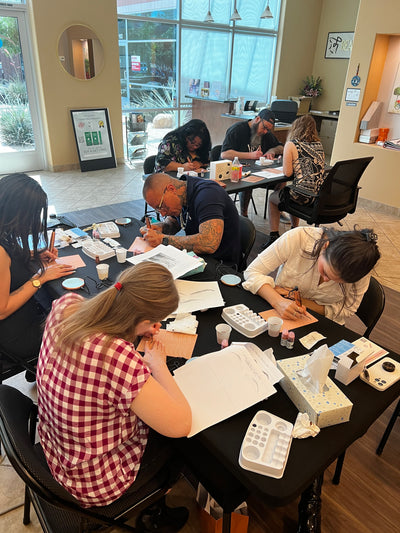
Look for training that includes in-person instruction, sanitation protocols, machine operation, pigment theory, skin anatomy, facial mapping, color correction basics, consultation forms, contraindications, and guided work on live models. Working on latex can help you understand hand movements, depth, needle angles, and pattern building. Live-model experience teaches the details that practice skins cannot: client communication, skin texture, bleeding, comfort, symmetry adjustments, and decision-making under real conditions.
The instructor matters just as much as the curriculum. Learn from someone with active service experience and salon-business knowledge, not only a large online following. An experienced educator can identify weak pressure, inconsistent saturation, poor stretching, or an unsuitable design before those mistakes become part of your routine.
At Arizona Permanent Makeup Training Academy, students can pursue structured, state-approved training with hands-on instruction, live models, professional equipment, and paperwork support designed to help turn education into a real working path.
Build Technical Skill Before You Build a Client List
Your early work should be focused on consistency, not speed. Cosmetic tattooing requires controlled depth, clean line work, balanced saturation, stable hand positioning, and a design that suits the client rather than a trend. A brow that looks sharp on one face can look harsh, uneven, or poorly placed on another.
Spend time practicing the core skills behind every service: mapping and symmetry, skin stretching, needle selection, machine settings, pigment placement, and healed-result evaluation. The healed result is the real result. Fresh work can appear bold and even immediately after an appointment, but skin type, aftercare, sun exposure, oil production, immune response, and pigment choice all influence retention.
Document your work carefully. Take consistent before-and-after images with good lighting, record the pigment and needle configuration used, and photograph healed results when clients return. This record helps you improve faster because it connects your technique choices to real outcomes.
Do not rush into advanced services because they appear profitable. Nano brows, eyeliner, lip blush, camouflage work, and scalp micropigmentation each require dedicated training. Expanding too early can dilute your results. Expanding after you have built solid fundamentals can elevate your income and reputation.
Set Up a Safe, Professional Work Environment
Your workspace is part of your brand. Clients notice whether your station is organized, your tools are properly prepared, and your process feels calm and professional. More importantly, your environment must support safe procedures and local compliance.
Use professional-grade equipment and single-use disposable supplies where appropriate. Follow strict cleaning and barrier practices between every client. Keep consent forms, health histories, photo releases, pre-care instructions, aftercare instructions, and treatment records organized and secure. Your consultation should also include an honest conversation about expectations, healing, touch-up policies, and situations where a client may not be a candidate.
Avoid making guarantees. Skin does not heal identically from person to person, and no ethical artist promises a specific retention result. Clients respond well to transparency. Explain what they can reasonably expect, why touch-ups may be needed, and what choices will support the best possible healed outcome.
Price for Skill, Time, and Business Growth
New artists often underprice because they want to fill their schedule. Introductory model pricing can make sense while you are gaining supervised experience and building a portfolio. Staying underpriced after your skills improve is a different problem. It can attract clients who do not value the service, make reinvestment difficult, and create burnout before your business has a chance to grow.
Build your pricing around the full cost of delivering a safe service: supplies, pigments, disposables, rent, insurance, licensing, taxes, payment processing, continuing education, touch-up time, and the hours spent consulting and following up. Then compare your work, experience, and local market with honesty.
Your goal is not to be the cheapest option. Your goal is to become the trusted option for clients who want quality, safety, and a technician who understands their features and concerns. Strong consultation skills, clear policies, and healed-work photos often do more for premium pricing than a discount ever will.
Turn Training Into a Sustainable Beauty Business
A certification is a starting line. After training, create a simple business system before your calendar gets busy. Decide whether you will rent a suite, work in a salon, join an existing studio, or build toward your own location. Each option has trade-offs involving overhead, independence, mentorship, visibility, and compliance responsibility.
Treat your portfolio as proof, not just promotion. Share clear images of your healed work, explain the service process in plain language, and show clients that you take safety seriously. Ask for reviews after a positive healing outcome, not immediately after the procedure when the final result is still unknown.
Keep investing in education as your career grows. Advanced courses can help you refine a niche, correct previous work, serve more skin types, or add services that fit your market. The artists who last are not the ones chasing every trend. They are the ones who keep their standards high, evaluate their results, and make thoughtful upgrades to their skill set.
Your first machine, first model, and first appointment can feel intimidating. Start with credible education, practice with purpose, follow your local requirements, and let your results earn the next opportunity. A well-built cosmetic tattoo career gives you more than a new service - it gives you a specialized skill you can grow into a business of your own.

Leave a comment