

Permanent Eyeliner Training for Beginners
A sharp, smudge-proof lash line can look deceptively simple. For a permanent makeup artist, creating it means working millimeters from the eye while managing skin tension, pigment placement, symmetry, sanitation, client comfort, and healing expectations. That is why permanent eyeliner training for beginners must be more than a one-day demonstration and a certificate.
For aspiring artists, eyeliner can become a high-value specialty that keeps clients coming back for touch-ups, additional services, and referrals. But it is not the place to rush. The right education gives you a controlled path from understanding the machine to completing a polished procedure with confidence and professional judgment.
What Beginners Need From Eyeliner Training
A quality beginner program should start with the fundamentals behind safe cosmetic tattooing, not simply the visual style of an eyeliner tattoo. Before an artist works on a live model, they need to understand bloodborne pathogen prevention, workstation setup, single-use supplies, cross-contamination control, informed consent, contraindications, and aftercare.
Eyeliner procedures require especially careful client screening. Clients with active eye infections, certain medical conditions, recent eye surgery, or irritated skin may need to postpone treatment or obtain clearance from an appropriate medical professional. A trained technician learns when to proceed, when to adjust expectations, and when to say no. That decision protects the client, the artist, and the reputation of the business.
The technical foundation matters just as much. Students should learn machine control, needle configurations, pigment basics, skin depth, hand speed, stretch, and saturation. On the eyelid, inconsistent depth can lead to poor retention, unnecessary trauma, or a result that heals unevenly. The goal is not to force pigment into the skin. It is to create clean, controlled implantation that respects delicate tissue.
Permanent Eyeliner Training for Beginners: Skills to Build First
Most new artists want to begin with a dramatic wing. That ambition is understandable, but it is smarter to build predictable results first. Lash enhancement eyeliner is often the strongest entry point because it teaches precision along the lash line without asking a beginner to create an extended shape that must match perfectly on both eyes.
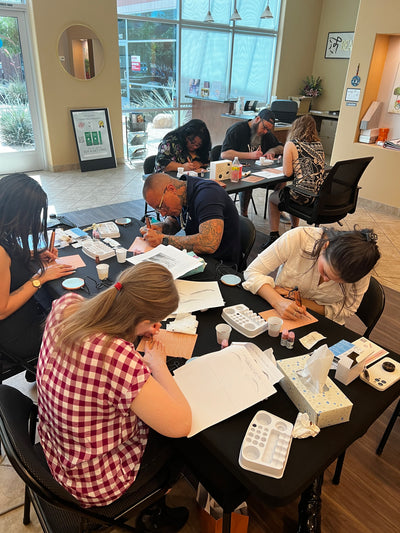
A structured course should move from theory and mapped practice to supervised work on live models. Practicing on artificial skin builds familiarity with machine rhythm and line consistency, but it cannot reproduce blinking, skin movement, facial asymmetry, or the emotional responsibility of serving a real client. Live-model experience is where students learn to communicate, position the client, make measured design decisions, and work efficiently without compromising quality.
Students should also study the differences between a subtle lash enhancement, a classic eyeliner, a shaded liner, and a winged design. Each treatment has a different level of complexity and a different ideal client. A client may request a bold wing, yet their eye shape, lid space, skin condition, or lifestyle may call for a softer approach. Professional artistry includes guiding the client toward a result that will heal beautifully and age well.
Symmetry Is About Balance, Not Copying
Human faces are naturally asymmetrical. One eye may sit slightly higher, one brow may arch differently, and one lid may have more visible space. A beginner who tries to make both liners mathematically identical can overwork the skin chasing a result that does not exist.
Training should teach artists to assess the entire face in an upright position, map conservatively, and create visual balance. Small adjustments may be necessary, but every adjustment must be intentional. This is one reason in-person instruction is so valuable: an experienced educator can spot a mapping issue before pigment is implanted.
Equipment Should Support Your Education
A beginner should not have to guess which machine, needles, pigments, topical products, and disposables are appropriate for professional eyeliner work. Training packages that include professional equipment remove a major barrier between learning in class and practicing responsibly afterward.
Still, a machine-inclusive course is only valuable if students are taught how and why to use the equipment. The machine is not the artist. Artists need to understand needle selection, voltage guidance, pigment flow, proper cartridge handling, and how to set up and break down a treatment area safely.
Buying the cheapest equipment online can create avoidable problems. Inconsistent needle quality, unknown pigment ingredients, and poor sanitation practices can put a new business at risk. Investing in education and professional-grade supplies supports better work from the beginning.
Credentials, State Rules, and a Real Career Plan
Permanent makeup rules vary by state, county, and local health authority. Some areas require specific training hours, bloodborne pathogen education, permits, inspections, or additional licensing. A serious student should never assume that one certificate automatically authorizes them to work anywhere.
This is where a state-approved education provider and paperwork support can make a practical difference. Students need clear guidance on the requirements that apply to their intended location, the documents they must keep, and the steps required before accepting paying clients. Nationwide board-accepted certification can strengthen professional credibility, but it should always be paired with compliance in the jurisdiction where you work.
At Arizona Permanent Makeup Training Academy, students can pursue hands-on permanent makeup education with live models, professional tools, and guidance designed to support the move from student to working technician. For an entrepreneur, that support is not an extra. It is part of building a business that can operate with confidence.
Plan for the Business Before You Graduate
Eyeliner can be a profitable addition to a permanent makeup menu, but income depends on more than technical skill. You will need a compliant place to work, reliable scheduling, consultation procedures, clear pricing, quality photography, aftercare systems, and a plan for touch-ups.
Begin with a portfolio that shows healed work when possible, not only fresh procedures. Fresh eyeliner often appears darker and more defined than its healed result. Honest portfolio building helps clients understand the process and helps you attract the right service requests.
Pricing should reflect your training, time, supplies, overhead, and expertise. Underpricing may feel like an easy way to fill a schedule, but it can make it difficult to deliver the careful consultation, setup, procedure time, and follow-up each client deserves. As skill and demand grow, your pricing can grow with them.
Questions to Ask Before You Enroll
Not every eyeliner class offers the same preparation. Before investing, ask whether the curriculum includes sanitation, contraindications, machine technique, pigment theory, mapping, aftercare, touch-up planning, and live-model work. Find out who teaches the course and whether they have active industry and salon-business experience.
Ask what equipment is included, how much supervised practice you receive, and what support is available after class. A course can be short without being shallow, but only when its schedule is focused, its instruction is hands-on, and students have a clear practice plan afterward.
Also ask how the school supports licensure or board paperwork. The best program does not make promises that ignore local laws. It gives you the information and professional direction needed to take the next step correctly.
Your First Procedures Should Be Deliberate
After training, choose early clients carefully. Start with appropriate candidates who understand that cosmetic tattooing is a process and that a touch-up appointment is often part of achieving the final result. Use thorough consultations, document medical history, take clear before-and-after photos, and give written aftercare instructions every time.
Do not let social media pressure you into advanced wings before your fundamentals are consistent. A clean lash enhancement on a happy client is stronger evidence of your skill than a dramatic design completed before you were ready. Precision builds trust, and trust is what builds a lasting permanent makeup business.
The right training gives you more than a new service to advertise. It gives you the judgment to work safely, the technical discipline to produce refined results, and the foundation to turn a specialized beauty skill into a career you can confidently grow.

Leave a comment