

Scalp Micropigmentation Certification Training
A scalp micropigmentation service is not simply a series of tattooed dots. It is a visual hairline restoration treatment that can change how a client sees themselves in the mirror. That level of responsibility is exactly why scalp micropigmentation certification training should be chosen for more than a certificate at the end. The right education builds the technical control, sanitation habits, client consultation skills, and business judgment needed to deliver work you can stand behind.
For beauty professionals, tattoo artists, estheticians, and future entrepreneurs, SMP can be a powerful specialty service. It serves men and women experiencing thinning hair, pattern baldness, scars, alopecia, and post-transplant hair loss. It also requires precision that cannot be rushed. A strong training program gives you a practical route from interested beginner to confident professional with a service clients are willing to invest in.
What Scalp Micropigmentation Certification Training Should Teach
A meaningful SMP education starts with the science behind the service. Students need to understand the scalp, hair follicle appearance, skin undertones, pigment behavior, and the way hair density changes across a natural-looking result. A dot that is too large, too dark, too deep, or too evenly placed can make a treatment look artificial. The goal is controlled imperfection that resembles real follicles, not a stamped pattern.
Training should also cover machine handling, needle selection, pigment dilution, depth control, stretching techniques, and dot placement. These skills work together. A technician may understand hairline design but still produce inconsistent retention without proper depth. Another may create clean impressions yet struggle with color selection on warm, cool, mature, oily, or heavily sun-exposed skin.
The best courses teach students how to assess those variables before the first mark is made. That includes identifying contraindications, reviewing medical history within the appropriate scope of practice, recognizing when a client needs medical clearance, and knowing when not to perform a service. Professional judgment protects the client, your reputation, and your future business.
Hairline Design Is a Client-Specific Skill
Hairline design is one of the most visible parts of SMP work. A low, sharp hairline may look appealing in a photo, but it may not age well for every client. Training should teach you to consider age, facial structure, current hair-loss pattern, ethnic background, lifestyle, and the client’s long-term expectations.
A responsible artist does not promise a dramatic result that will become difficult to maintain. Instead, they create a conservative, believable plan and explain how density builds over multiple sessions. That consultation process is a professional skill, not an optional sales conversation.
Why Hands-On Practice Matters More Than a Fast Certificate
Online education can be useful for theory, demonstrations, and ongoing review. It cannot fully replace supervised hands-on work. SMP is a tactile service. You need to feel machine rhythm, observe skin response, practice consistent pressure, and learn how pigment behaves from one area of the scalp to another.
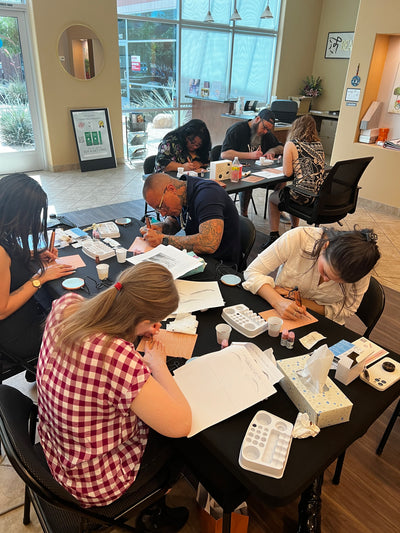
Look for scalp micropigmentation certification training that includes structured practical exercises before moving to live models. Students should have time to practice dot patterns, gradients, hairline transitions, scar blending, and density work under instructor feedback. Live-model experience is especially valuable because real skin does not behave like practice material.
A course should not push students onto a model before they understand sanitation and basic technique. At the same time, a course with no live-client component can leave graduates unprepared for the pace, emotion, and decision-making involved in a real appointment. The strongest path combines theory, guided practice, demonstrations, and supervised model work.
Certification, Licensure, and State Requirements Are Not the Same Thing
This is where many aspiring artists get confused. A certification confirms that you completed a training program. It does not automatically grant permission to practice in every city or state. Requirements can vary based on how scalp micropigmentation is classified locally, whether it falls under tattooing, body art, cosmetic tattooing, or another category.
Before enrolling, ask whether the program provides support with paperwork, health department requirements, bloodborne pathogens education, local permits, and documentation needed for your next step. A school can help simplify the process, but every technician is responsible for understanding the rules where they intend to work.
For students who want a more structured route, Arizona Permanent Makeup Training Academy offers state-approved education with hands-on instruction, professional tools, and support designed to help students move from training into practice. That operational guidance matters when your goal is not just learning a technique, but launching a legal, client-ready service.
Questions to Ask Before You Enroll
Not all certifications carry the same practical value. Ask how many days of training are included, whether live models are part of the course, what equipment is provided, and how much direct instructor feedback you will receive. You should also ask whether the program teaches consultations, consent forms, aftercare, photography, pricing, and client retention.
A lower-cost class may seem attractive until you discover it excludes a machine, pigments, practice supplies, or model experience. On the other hand, the most expensive course is not automatically the best fit if it provides little individualized support. Compare what you receive, not just the tuition number.
The Business Side of Building an SMP Career
Technical ability gets clients results. Business skills help you create a career. Because scalp micropigmentation is a specialized, high-value service, clients expect a polished experience from the first inquiry through healed results. Your brand, consultation process, pricing structure, before-and-after portfolio, and follow-up communication all influence whether clients trust you.
Training should prepare you to explain the service clearly without making unrealistic claims. Clients need to understand that SMP creates the appearance of follicles and density. It does not regrow hair. It may complement hair restoration plans, but it is not a medical treatment. Clear expectations reduce dissatisfaction and strengthen referrals.
Your pricing should reflect your training, supplies, time, market, and the complexity of the case. A small scar camouflage treatment and a full scalp density restoration should not be priced the same way. Most treatments also require multiple sessions, so clients need a transparent plan before booking. When you communicate with confidence and honesty, you position yourself as a specialist rather than a discount provider.
Photography deserves attention as well. Consistent lighting, clean angles, client consent, and unedited documentation help demonstrate your work accurately. A strong portfolio should show hairline work, density treatments, scar camouflage when applicable, and healed results over time. Prospective clients are looking for proof that you can create natural work on people with concerns similar to their own.
Who Is a Good Fit for SMP Training?
Scalp micropigmentation can be an excellent addition for established PMU artists, tattoo professionals, barbers, salon owners, and beauty entrepreneurs. It can also be a starting point for someone new to the industry, provided they choose a program that teaches fundamentals instead of assuming prior machine experience.
The right student is patient, detail-oriented, coachable, and willing to practice. This is not a service to learn casually over a weekend and immediately market as expert-level work. It rewards artists who respect procedure, study skin and pigment behavior, and continue refining their technique after certification.
There is also a meaningful human side to the work. Hair loss can affect confidence, identity, and social comfort. Clients may arrive after years of trying products, procedures, or hairstyles that did not give them the result they wanted. When you approach their treatment with skill and empathy, SMP becomes more than a revenue stream. It becomes a service built on trust.
Choose training that makes you earn that trust. Invest in education that gives you real practice, credible support, and a clear understanding of what it takes to work professionally. The certificate matters, but the confidence you build through disciplined training is what clients will remember.

Leave a comment