

Scar Camouflage Skills That Build a Specialty
A healed scar can carry far more than a change in texture or color. For many clients, it is a daily reminder of surgery, injury, pregnancy, weight changes, or a medical experience they did not choose. Scar camouflage gives trained artists a meaningful way to help clients feel more comfortable in their skin while building a specialized, high-value paramedical service.
This is not a basic tattoo service with skin-tone ink. Successful work requires a careful eye, advanced color knowledge, conservative technique, and the judgment to know when a client is not a candidate. For permanent makeup artists, estheticians, and tattoo professionals ready to move beyond standard cosmetic services, it is a specialty that can create both professional differentiation and real client impact.
What Scar Camouflage Can Do
Scar camouflage is a form of paramedical tattooing that uses custom-mixed pigment to reduce the visual contrast between a scar and the surrounding skin. The goal is not to erase a scar, flatten raised tissue, or promise an exact skin match. The goal is to soften the appearance of color difference so the area attracts less attention.
Artists may work with surgical scars, injury scars, stretch marks, burns, and certain areas of hypopigmentation when the tissue has fully healed and the client is an appropriate candidate. Every result depends on the scar's age, texture, location, skin tone, healing response, and the way pigment settles into that specific tissue.
What the procedure cannot replace
A cosmetic tattoo artist does not diagnose skin conditions or treat medical concerns. Scar camouflage cannot correct active inflammation, remove scar tissue, repair a wound, or guarantee that pigment will behave exactly like it does in healthy skin. Raised scars, keloid-prone skin, active acne, dermatitis, vitiligo, unstable pigment conditions, and recently healed procedures require added caution and may require medical clearance or a referral.
That honesty protects the client and the artist. It also builds trust. Clients should hear realistic expectations before they book, not after a procedure has started.
Why Scar Camouflage Is a Valuable Specialty
The beauty market is full of artists offering brows, lips, eyeliner, and standard tattoo work. Those services can be highly profitable, but specialization creates a clearer reason for clients to choose one professional over another. Scar camouflage positions an artist within the growing restorative side of cosmetic tattooing, where technical skill and thoughtful consultation matter as much as artistic ability.
It can also complement an existing service menu. A permanent makeup artist already understands pigment implantation, sanitation, client consent, and healing protocols. A tattoo artist may already have strong machine control and color-mixing instincts. An esthetician may have deep experience with skin assessment and client care. Formal scar camouflage education helps connect those skills to a procedure with different tissue behavior, different expectations, and a higher need for careful screening.
For entrepreneurs, that distinction matters. Clients seeking restorative services often research carefully, value credentials, and are willing to invest in a professional who can explain the process with confidence. Your education, portfolio, consultation standards, and before-and-after documentation become part of the service itself.
Scar Camouflage Requires More Than Color Matching
A client may point to a scar and say, “I just want it to match.” The professional response is more nuanced. Skin is not one flat shade. It carries undertones, surface warmth, translucency, and natural variation that can shift across the body and throughout the year.
Skin assessment comes first
Before pigment is selected, the artist needs to assess whether the tissue is mature, stable, and suitable for implantation. A scar that is still red, pink, itchy, changing, or sensitive may not be ready. In many cases, waiting is the safest and most ethical recommendation.
Texture also affects the outcome. Flat, pale scars may accept camouflage more predictably than thick, fibrous, shiny, or deeply indented scars. Stretch marks can vary even within a small area. The same pigment blend may heal differently from one line to the next, which is why patch testing and gradual sessions can be valuable tools.
Color theory drives natural-looking results
A strong scar camouflage artist does not reach for a single beige pigment and hope for the best. They evaluate the surrounding skin, identify undertones, and build a custom color that accounts for how the selected pigment may cool, warm, lighten, or darken during healing.
This work often calls for patience. A conservative first pass may be preferable to depositing too much pigment. Light layering gives the artist room to reassess healed results and adjust future sessions. Overcorrecting can create a new visible contrast, which is exactly what the client came in to avoid.
Machine technique must respect scar tissue
Scar tissue is not healthy, untouched skin. It may be less elastic, denser, thinner, or more reactive. Needle choice, hand speed, pressure, depth, stretch, and pigment saturation must be adjusted accordingly. Too much trauma can compromise the result and increase healing concerns. Too little implantation may lead to poor retention.
That balance is learned through hands-on education, supervised practice, and repetition. It is not a skill to approach casually after watching a few social media videos.
Training for Scar Camouflage Builds Professional Confidence
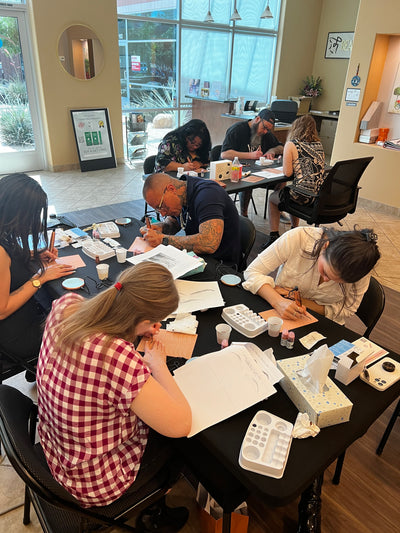
A quality training program should teach more than a procedure sequence. Students need a framework for evaluating candidates, documenting consultations, preparing a sterile setup, selecting equipment, mixing pigments, performing conservative applications, and supporting clients through aftercare and follow-up.
Live-model experience is especially valuable because real skin does not behave like practice material. It teaches artists to communicate under pressure, adjust technique in the moment, and work with the care required for a restorative service. Training should also address contraindications, informed consent, client photos, touch-up planning, and the limits of an artist's scope of practice.
For professionals building a career, education should remove operational uncertainty as well as technical uncertainty. State-approved training, board-accepted certification where applicable, equipment guidance, and licensure paperwork support can make the path from student to working artist far more direct. AZPMU approaches specialty education with that career-focused mindset: hands-on practice, professional tools, and the business knowledge needed to turn technical training into a service clients can book.
Building a Scar Camouflage Service Clients Trust
The consultation is where the service begins. Give clients space to explain what they want to improve, but avoid promising an outcome before you have assessed the area. Discuss the scar's history, age, previous treatments, medications, allergies, sun exposure, and whether it has changed recently. If there is any uncertainty, pause and refer the client to an appropriate medical professional.
Set expectations around multiple sessions. Many areas require more than one appointment, with healing time between visits. Explain that the immediate color will not represent the healed result and that scar tissue may retain pigment unevenly. Clear language avoids disappointment and helps clients understand why a thoughtful plan is better than a rushed procedure.
Photography matters, too. Consistent before-and-after images show the true value of your work, help track healing progress, and build a credible portfolio. Use the same lighting and angle whenever possible. Do not filter results or present a fresh procedure as a healed outcome. In a specialty built on trust, accurate documentation is stronger marketing than exaggerated claims.
Pricing should reflect the time spent on consultation, custom color formulation, procedure work, follow-up, supplies, and the expertise required to perform safely. Competing on the lowest price can attract the wrong expectations. Position the service around professional assessment, personalized treatment planning, and a respectful client experience.
A Specialty With Purpose and Potential
Scar camouflage is not for artists looking for a quick add-on. It is for professionals willing to study skin, practice restraint, and take responsibility for every recommendation they make. Done well, it can become a defining part of a beauty business: one that combines advanced artistry with a service that helps clients move through the world with greater confidence.
The next step is not simply learning how to implant pigment. It is learning how to assess, communicate, document, and deliver results with the level of care this work deserves.

Leave a comment